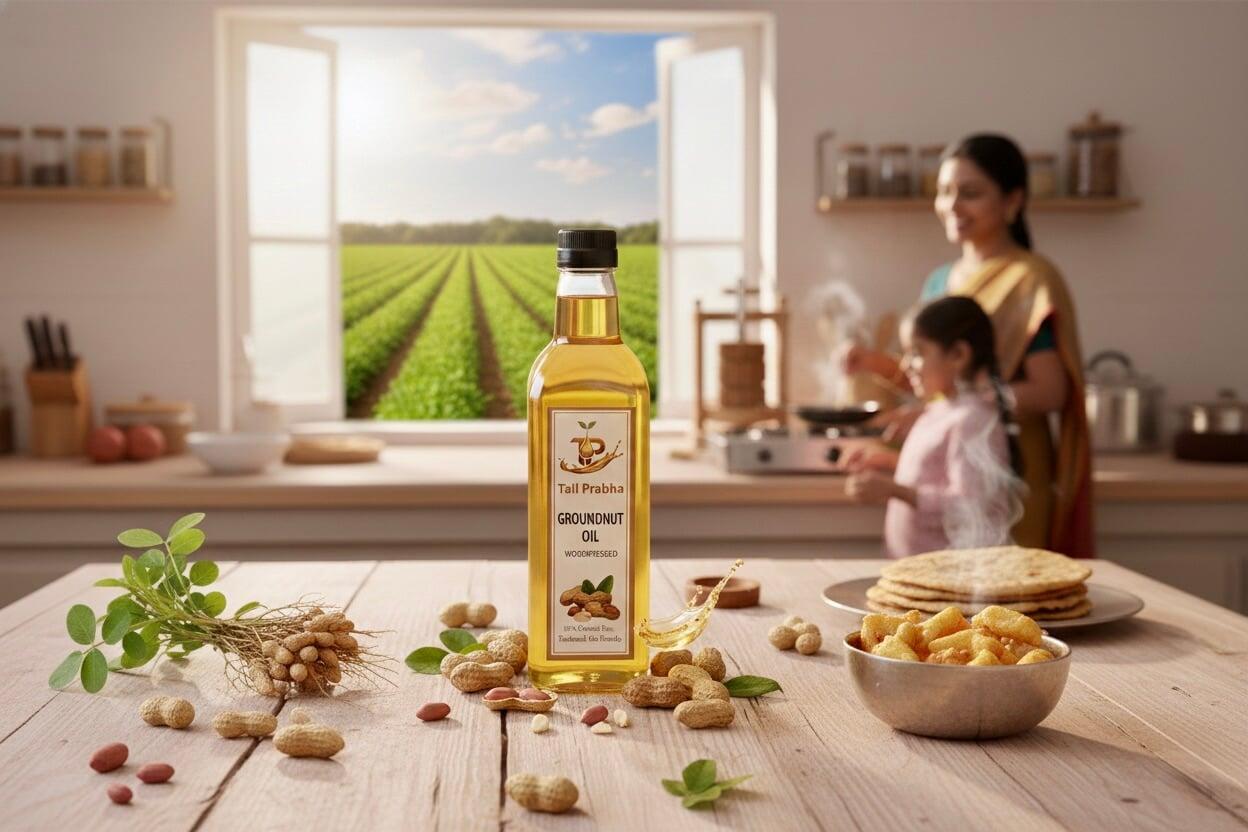
Do you remember the distinct smell of your grandmother’s kitchen when she was frying pooris or making a fresh batch of mango pickle? It wasn’t just the spices. It was the oil.
Somewhere in the last few decades, we lost that smell. We traded thick, golden, aromatic oil for transparent, odorless liquids in plastic pouches. We were told that "refined" was better. But if you look at our history, we might have left the best part of our diet behind.
This is the story of how the humble peanut, or Mungfali, became the backbone of the Indian kitchen, and why the ancient method of wood-pressing is making a comeback.
The "Refined" Mistake
To understand why wood-pressed oil matters, we have to look at what happened to modern oil.
Most oils you find in the supermarket today are extracted using hexanes and high heat. This industrial process squeezes every last drop out of the nut, but it also strips away the nutrients. To make it edible, it has to be bleached and deodorized.
The result? A "dead" oil. It has no smell and no taste because the natural goodness has been processed out of it.
The Magic of the Wooden Ghani (Chekku)
Our ancestors didn't have heavy machinery. They had the Ghani (or Chekku in the South).
This traditional machine used a heavy wooden pestle to slowly crush the groundnuts. It was often driven by an ox walking in circles. The most important part of this process was the speed. Because it moved slowly, no heat was generated.
This is the secret.
When you keep the temperature low (usually below 50°C), you preserve the oil's soul. The Vitamin E, the natural antioxidants, and those healthy mono-unsaturated fats stay intact. This is what we call "Cold Pressed" or "Wood Pressed."
Why Groundnut? The Indian Superfood
While olive oil gets a lot of global marketing fame, Groundnut oil is the true hero of the Indian kitchen. It is perfectly suited for our style of cooking.
High Smoke Point: Unlike olive oil, which burns easily, groundnut oil can handle the high heat required for deep frying bhajiyas or making a tadka for your dal.
The Flavor: True wood-pressed groundnut oil has a nutty, slightly sweet aroma. It enhances the food rather than hiding in the background. It makes your chutneys taste fresher and your curries richer.
The Taila Prabha Standard
At Taila Prabha, we are revisiting these roots. We use the traditional wooden churner method to extract our oil. We select the best sun-dried groundnuts, remove the bad ones, and press them slowly.
We don't filter it through chemical meshes. We let the oil sit so the sediments settle naturally. This is why our oil might look a little cloudy or have a thicker texture than the water-like refined oils. That thickness is proof of purity.
We believe that oil shouldn't just be a lubricant for your pan. It should be an ingredient that adds health and life to your food.
Switch back to the oil your body recognizes. Taste the difference of the Ghani.